
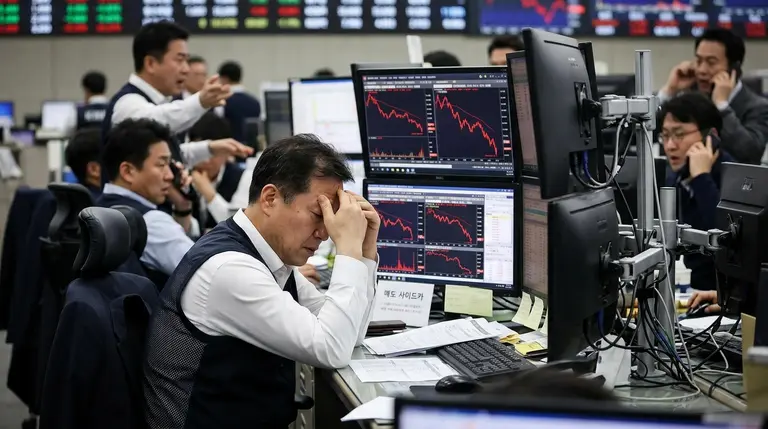
The KOSPI plunged more than 6% intraday as shock over a Chinese memory maker’s technological advances coincided with weakness in U.S. semiconductor stocks. The 6,000 level, seen as a line of defense for the index, gave way with little resistance. Investor sentiment rapidly froze as a sell-sidecar was triggered for the first time in about two months.
According to the Korea Exchange, the KOSPI opened at 6,186.08, down 3.10% from the previous session, and quickly deepened its losses. At around 9:47 a.m., a temporary halt to program sell orders—a sell-sidecar—was triggered on the main board. It was the first such action since Aug. 20. The index later fell as low as 5,950.00 intraday, losing as much as 6.80%, in a session marked by extreme volatility.
The main drivers of the selloff were a massive exodus of foreign investors and weakness in leading semiconductor stocks. Foreign investors had net sold 2 trillion won the previous day, then unloaded more than 2.4 trillion won worth of shares in the morning of Oct. 13 alone. Concerns about South Korea’s semiconductor industry grew after reports of technological advances by China’s ChangXin Memory Technologies (CXMT). Samsung Electronics and SK hynix shares plunged in tandem, falling as much as 8% to 9% intraday and weighing heavily on the index.
A reporter covering the stock market during the morning session said, “Individuals and institutions are both net buyers, while foreign investors are pulling the index down by selling more than 2 trillion won,” adding, “The leading semiconductor stocks are also falling across the board and driving the overall decline in the index.”
Meanwhile, the KOSDAQ also fell more than 4%, adding to market anxiety. Domestic buying demand is far too weak to offset the foreign investors’ aggressive selling, which has continued for six consecutive trading days. As a result, downward pressure on South Korea’s stock market is expected to persist for the time being.


댓글 (0)
댓글을 작성하려면 로그인이 필요합니다.
로그인하기